
Alibaba Group Holdings Ltd may scrap plans to invest in online marketplace Snapdeal, technology website Recode has reported.

Can we make high speed 4G Internet available at 10 cents per GB, and make all voice calls free of cost -- that too in a large and diverse country like India? Can we make high-quality but simple breast cancer screening available to every woman, that too at the extremely affordable cost of $1 per scan? Can we make a portable, high-tech ECG machine which can provide reports immediately and that too at the cost of 8 cents a test? Can we make an eye imaging device that is portable, non-invasive and costs 3 times less that conventional devices? Can we make a robust test for mosquito-borne dengue, which can detect the disease on day 1, and that too at the cost of $2 per test? Amazingly, says Dr R A Mashelkar, the eminent scientist, all this has been achieved in India, not only by using technological innovation but also non-technological innovation.

Nasscom and the Chinese government have given the task of creating a matchmaking platform to Zeta-V, set up in June 2017 in Shanghai by Sujit Chatterjee, former CEO of TCS China, and Rangarajan Vellamore, former CEO of Infosys China.

Indian firms selling SAAS products have got a bonanza as companies meet, manage and sell remotely. The top five firms - Zoho, Freshworks HighRadius, Druva, and Icertis - account for 33 per cent of the market share. Chennai, India's SAAS centre, alone generates $1 billion in annual revenue. Yuvraj Malik explains how these companies are planning their next phase of growth.

Telecom subscriber base crossed the 95-crore mark in August, after a gap of more than two years, on the back of higher mobile users whose number touched 92.43 crore.

The dual-technology operator plans to divert its mobile customers and those who use mobile internet to the GSM side of its business, and devote the CDMA business exclusively to dongles.

We have our own problems for sure and they are not trivial, but for now, our economy is in not too bad a shape, our politics is as personality-driven and authoritarian as that of most countries in the world. We must make the best of what we have and not be excessively unhappy looking at the grass on the other side of the septic tank which may not be greener after all!, observes Shreekant Sambrani.
.jpg)
Though the party's pre-poll promises include increasing the focus on technology, this isn't a new idea.

Chinese telcos hold 60-100 MHz of spectrum, while Indian companies hold 13-15 MHz of spectrum.

Niraj Bhatt discovers how a CFO 'without a finance background' made it to the corner office at TCS.

'The success of the country's economic policies is affirmed by receipt of FDI of $15 billion last year, the highest in the Asia-Pacific after China and India, and well ahead of Indonesia, Australia, Singapore, Malaysia and Thailand,' notes Ambassador Talmiz Ahmad.

Brokers like Vasudevan are struggling to keep themselves in tune with this super-informed, new-generation retail investor.
Ajit Mishra, Vice President, Research, Religare Broking, answers readers's queries on stocks they own or want to buy.

'After three days, most people resigned to the idea of living with minimum facilities. By then, they had stopped getting angry, irritated and worried. As days passed by, one heard less and less complaints.' 'In a crisis like this, you expect the administration to help people but I didn't see any administration here. I saw only NGOs and people helping themselves' 'I feel people have not leant anything from this disaster. Unless we learn to respect nature, learn to take corrective measures, this will happen again and again.' N Rajasekharan Nair recounts his ordeal as the flood waters rose around his apartment complex.

'Jin Jiang had invested in Louvre Hotels.' 'Louvre, a couple of months ago, took a majority in Sarovar hotels.' 'So they are coming in now.' 'Look at the Chinese -- two quarters ago they took 25 percent in Hilton.' And then HNA also took majority in Carlson (Radisson).'
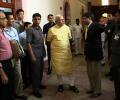
Who are the men the prime minister relies on to execute his impressive agenda?

While chips have become ubiquitous, Moore's Law has remained a self-fulfilling prophecy even half a century later. Not bad for an industry where the time scale is not measured in decades and centuries, but in annual quarters, says Shivanand Kanavi.
